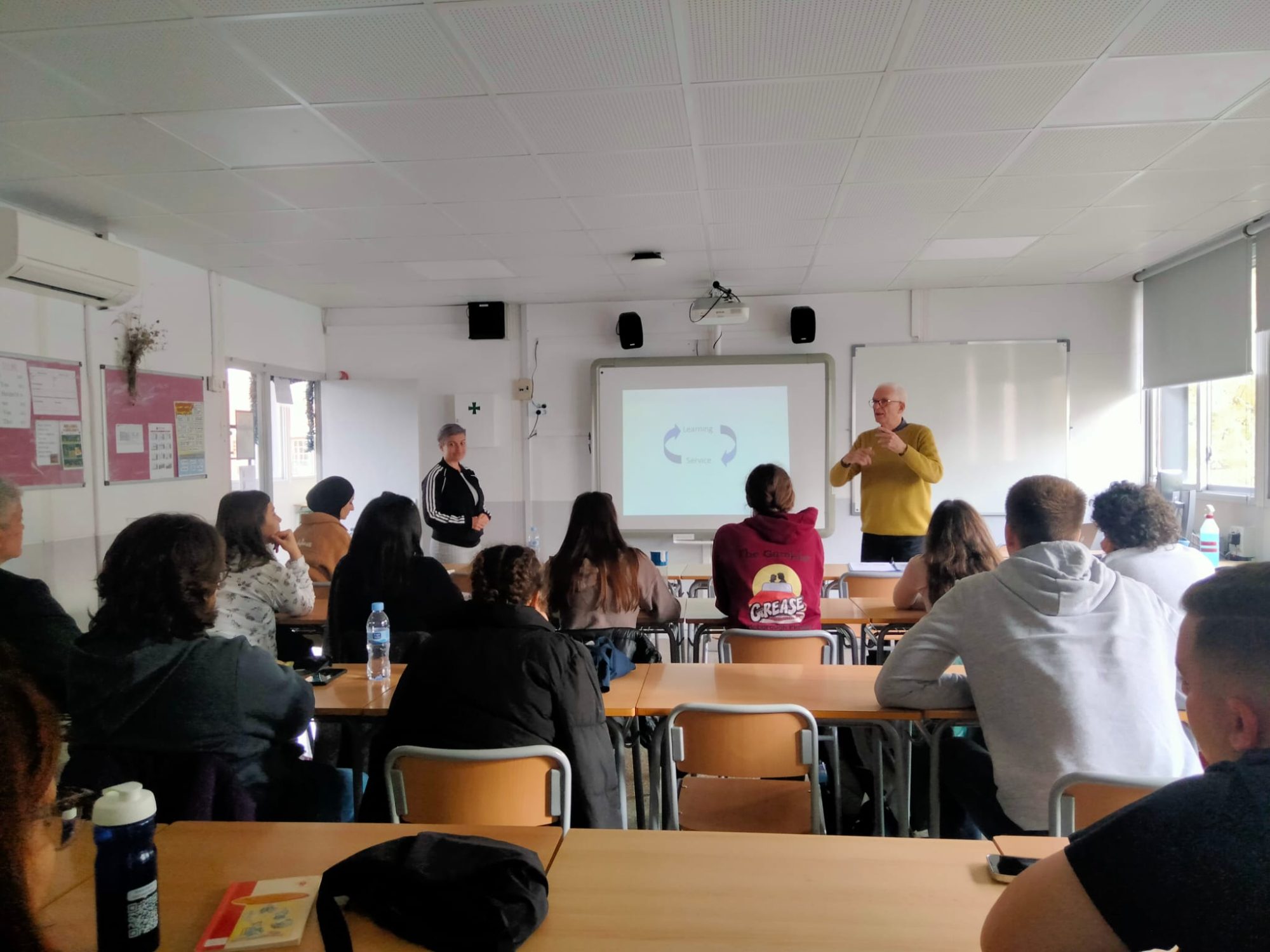
On the first outing day of the “Equality in Network” training course in Badalona focused on social inclusion, our hosting organization La Rotllana planned a morning focused on the Learning for Service (L4S) methodology. On this day, we left our accommodation early and headed to the Centre de Formació d’Adults (school for adults) where we heard about the school itself first and then had a wonderful presentation by Josep Maria Puig Rovira, a knowledgeable former professor at the University of Barcelona that told us about the L4S methodology.
Learning for Service is an educational methodology combining learning processes and community service in a single well-articulated project that looks to improve a specific social issue or need within a community. Some key words to summarise this are need, service, learning, recognition, and collaboration. This means that there needs to be a need identified in the community that someone else is going to try and make it better and, in that process, they are going to be learning something. Some people behind this methodology known today are Dewey, Makarenko, and Baden-Powell. To give real-life examples, this could look like graphic design or marketing students designing ads or posters for non-governmental organizations that do not have the funds to hire somebody to do so; or primary school students collecting used oil from people’s houses to make soap out of them and at the same time to raise awareness to the harm that sending the oil down the drain does. However, this is not as simple as finding a necessity and trying to cater to it, there are a lot more components that go into a project like this. Let’s get into the intricacies of it.
Besides the basics of social needs, learning and the community service, the L4S methodology requires active participation from each participant. This means intervening in the decision making, the planning and the implementation of the project at hand. Being a part of projects under this methodology also fosters cooperation, group work, collaboration, and solidarity amongst participants. All projects require reflection all throughout and at the end in order to give personal, social, and political meaning to the experience, understand why we do what we are doing. Finally, we should mention recognition. Congratulating, celebrating, and disseminating the results is important for everybody involved for the sense of reward.
To wrap it up, the concept of this methodology could be confusing for some people and lead them to get it mixed up with volunteering or even an internship. In all three of these concepts, we have service and learning, but the definite definition comes with the emphasis placed on each one. In volunteering, the emphasis goes to the service component, in an internship, the focus is the learning, in Service Learning, we place the same weight in both the learning and the service, and here lies the difference.
